Craft
What Is the Khaleghi-Motlagh Edition, and Why Does It Matter When Reading the Shahnameh?
The Shahnameh is a single literary work, but its surviving manuscripts do not contain an entirely identical text. The Khaleghi-Motlagh edition is the result of a critical comparison of some of the oldest surviving manuscripts—a decades-long scholarly project intended to bring us as close as possible to Ferdowsi’s original text.
23 September 2026 · 9 min read
Email
Are There Several Versions of the Shahnameh?
Ferdowsi completed the Shahnameh around 1010 CE. However, neither the poet’s original manuscript nor a copy produced during his lifetime has survived. Over the centuries, the poem was repeatedly copied by hand, and every manuscript may contain scribal mistakes, omissions, rearranged verses, or additions introduced during later stages of transmission.
Scribes did not always reproduce texts as mechanically as a modern printing press. A copyist might replace an unfamiliar word with a more familiar one, alter a line to improve its metre, accidentally omit a verse, or add lines encountered in another version of the story. Consequently, two manuscripts of the Shahnameh may differ in their wording, number of verses, spelling of names, and occasionally even in their presentation of particular episodes.
The earliest known dated manuscript is preserved in the National Central Library of Florence. It was copied in 614 AH, corresponding to 1217 CE, and contains only the first half of the epic. Even this manuscript was therefore produced approximately two centuries after Ferdowsi completed the poem and does not preserve the entire work.
It is therefore important to distinguish between two terms:
A manuscript is a handwritten copy produced by a particular scribe.
A critical edition is a reconstructed text prepared by a scholar through the comparison and evaluation of several manuscripts.
For this reason, “the Khaleghi-Motlagh critical edition” is more accurate than “the Khaleghi-Motlagh manuscript.”
What Does a Critical Edition Actually Do?
A critical edition does not “correct” Ferdowsi’s poetry according to a modern editor’s taste, nor does it modernise the language. Its purpose is to reconstruct, as far as the surviving evidence allows, the form of the text that is most likely to reflect what Ferdowsi wrote.
Age alone does not determine the value of a manuscript. An early copy may contain omissions or serious errors in one section, while a later manuscript may preserve an older and more reliable reading inherited from an earlier source. The editor must therefore consider several forms of evidence:
the date and overall reliability of each manuscript;
the possible relationships between different copies;
the habits and characteristic errors of individual scribes;
Ferdowsi’s language and poetic style;
metre and rhyme;
narrative continuity;
the forms of historical and geographical names;
and, when necessary, evidence from related historical and epic texts.
The selected reading appears in the main text, while significant alternatives are recorded in the critical apparatus. This allows readers and researchers to see which readings exist in the manuscript tradition and to evaluate the editor’s decisions.
A critical edition is therefore not simply a clean reprint of one old manuscript. It is a scholarly reconstruction based on comparison, interpretation, and documented textual evidence.
Which Editions Were Available Before Khaleghi-Motlagh?
Several important printed editions of the Shahnameh appeared before Khaleghi-Motlagh’s work. Among the best known are the editions prepared by Turner Macan, Jules Mohl, and the team responsible for the Moscow edition.
Published between 1960 and 1971, the Moscow edition remained one of the most important scholarly texts of the Shahnameh for several decades. It represented a major advance in the critical study of the poem.
Nevertheless, some very early manuscripts—including the Florence manuscript—had not yet been properly identified or made available when the Moscow edition was prepared. The discovery and study of these witnesses, together with advances in manuscript studies and textual criticism, created the conditions for a new edition.
This does not mean that all earlier editions suddenly became worthless. Each belongs to the history of Shahnameh scholarship, and even the Khaleghi-Motlagh edition remains open to scholarly criticism and revision. Its distinction lies principally in the range of evidence examined, the method used to assess the manuscripts, and the systematic recording of variant readings.
How Did Khaleghi-Motlagh Edit the Shahnameh?
Djalal Khaleghi-Motlagh examined an extensive collection of Shahnameh manuscripts and selected a group of the most reliable witnesses as the principal basis of his edition. Studies of the project commonly refer to fifteen major manuscripts, including the Florence manuscript, the earliest surviving dated witness to the text.
He did not simply copy the oldest manuscript. Instead, he compared its readings with those found in other witnesses and evaluated them through linguistic, stylistic, narrative, metrical, and codicological evidence. Important textual differences were recorded in the critical apparatus so that other scholars could examine the basis of his decisions.
The main text was published in eight volumes. According to the publisher, the edition draws upon the earliest available manuscripts as well as a substantial body of critical scholarship. Publication of its first volumes began in the late 1980s.
Khaleghi-Motlagh worked on the project continuously for approximately thirty-six years. During its later stages, Mahmoud Omidsalar collaborated on the sixth volume and Abol-Fazl Khatibi on the seventh. The bibliographical records of Encyclopaedia Iranica likewise identify Volume VI as the work of Khaleghi-Motlagh and Omidsalar and Volume VII as the work of Khaleghi-Motlagh and Khatibi.
The project involved far more than selecting individual verses. It required the examination of numerous manuscripts, the recording of variant readings, the evaluation of difficult textual problems, and the preparation of extensive explanatory notes.
The accompanying Notes on the Shahnameh discuss vocabulary, grammar, the interpretation of individual lines, textual variants, metre and rhyme, and questions relating to mythology, history, customs, and material culture. The Persian Heritage Foundation lists the work as an eight-volume critical edition in its Persian Text Series.
Is the Khaleghi-Motlagh Edition the Definitive Text?
In the humanities, a “critical edition” does not mean that every word of the original text has been recovered with absolute and permanent certainty. Since Ferdowsi’s autograph has not survived and approximately two centuries separate the completion of the poem from the earliest dated manuscript, complete certainty is impossible.
A scholar may disagree with Khaleghi-Motlagh’s choice of a particular word or verse and propose another reading on the basis of manuscript, linguistic, metrical, or narrative evidence. The possibility of such criticism is not a weakness of critical editing; it is an essential part of scholarly practice.
The importance of Khaleghi-Motlagh’s work lies not in having ended all future discussion, but in having established one of the most extensive and systematic foundations for the critical study of the Shahnameh. The publisher and the Persian Heritage Foundation describe it as a major scholarly edition, and it is widely used as a reference text in contemporary academic research.
It is therefore more accurate to describe it as one of the most authoritative critical editions currently available than to claim that it offers the unquestionable final form of every verse.
Why Does This Matter to a General Reader?
At first glance, the difference between two words or two versions of a verse may appear relevant only to specialists. Yet a seemingly small textual variation can alter the meaning of a statement, the motivation of a character, or the connection between two parts of a story.
Imagine that a verse appears in a modern printed edition, but comparison with early manuscripts suggests that it was probably added several centuries after Ferdowsi. If that verse expresses an important judgment about a character, a community, a religion, or a historical event, accepting or rejecting it will directly affect our interpretation of the Shahnameh.
Readers therefore have a right to know how the text presented under Ferdowsi’s name was established. This is especially important for educational editions, translations, retellings, and reference works that claim to rest on reliable scholarship.
A critical edition, however, does not automatically make the Shahnameh easy for every reader. Many readers still need explanations of unfamiliar words, introductions to the stories, contextual information, and accessible prose retellings.
A reliable critical edition establishes a sound textual foundation. A well-prepared commentary or retelling helps readers enter and understand that text.
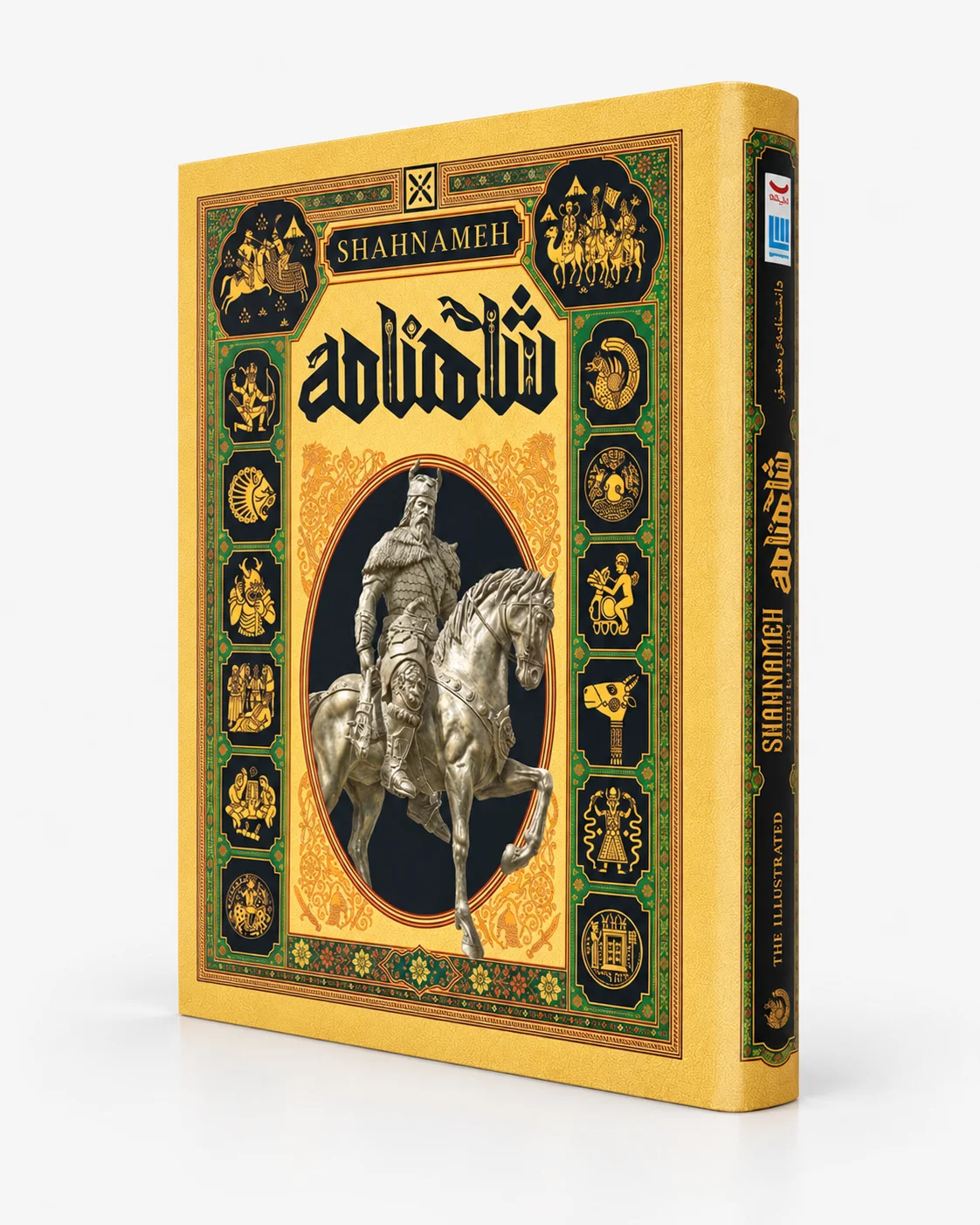
The Khaleghi-Motlagh Edition and The Illustrated Shahnameh: Story by Story
The Illustrated Shahnameh: Story by Story is not a complete verse edition of the Shahnameh, nor is it intended to replace the scholarly critical text. It retells the stories in prose and supplements them with information about characters, geography, historical contexts, mythology, and the cultural world represented in the epic.
Such a retelling must nevertheless rest on a reliable textual foundation. The Khaleghi-Motlagh critical edition serves as the textual basis of this illustrated encyclopedia. This means that the sequence of narratives, forms of names, and substance of the stories are grounded, as far as possible, in one of the most authoritative scholarly texts available rather than in an unspecified popular edition.
Mahmoud Omidsalar—a prominent Shahnameh scholar and one of Khaleghi-Motlagh’s collaborators—has contributed the introduction to this encyclopedia. His involvement helps connect specialised Shahnameh scholarship with the book’s accessible presentation for a broader readership.
The reference to the Khaleghi-Motlagh edition in the book’s publication details is therefore not merely a promotional phrase. It identifies the textual foundation on which the work has been built.
For readers who wish to discover the Shahnameh through an accessible, illustrated, story-by-story format, this choice offers an important assurance: simplification of presentation has not required abandoning a scholarly basis.
What Should You Check When Choosing an Edition of the Shahnameh?
Before purchasing or reading a particular Shahnameh, consider the following questions:
Which critical edition is the text based on?
Are the editor’s name and publication details clearly identified?
Does the book contain the complete poetic text, a selection, or a prose retelling?
Are later additions or disputed verses distinguished from the principal text?
Are definitions and explanatory notes based on reliable sources?
If the work is a retelling, does it clearly identify its textual basis?
The Shahnameh is one work, but the path by which its text has reached us was neither simple nor direct. Critical editing helps us navigate the surviving manuscripts and their differences and brings us, through documented evidence, closer to Ferdowsi’s words.
That is why asking, “Which edition is this Shahnameh based on?” is not a marginal or excessively academic question. It is part of reading one of the greatest works of Persian literature with care and awareness.