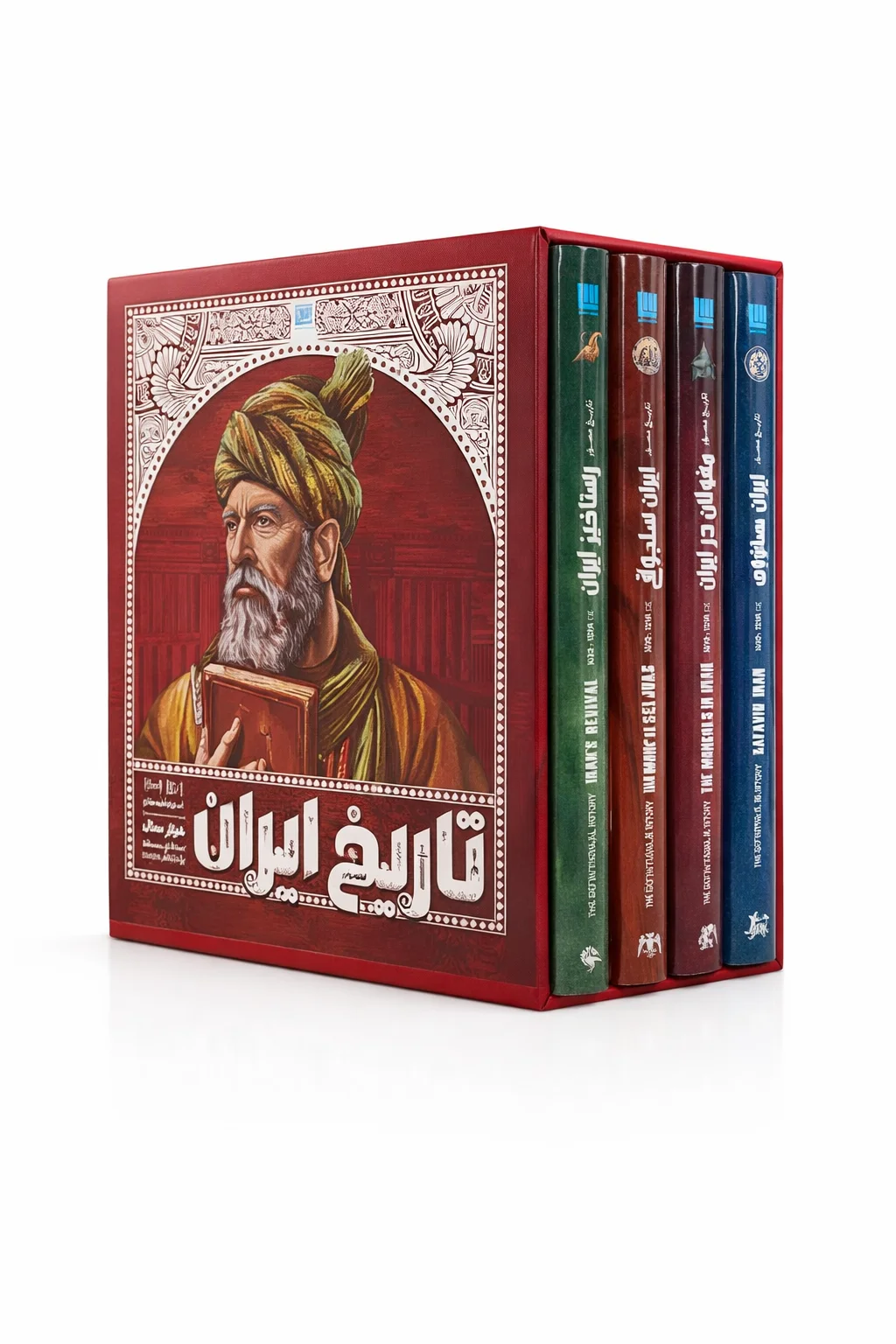
The Definitive Visual History of Iran (622–1722)
Iran Under the Seljuks
From The Definitive Visual History of Iran (622–1722)
€85.60Only 2 left
Prices include German VAT. Shipping is added at checkout, and VAT is recalculated from your delivery address (no VAT outside the EU; other EU countries may differ).
SKU: PX-BK-SEL-001
1
Ships in 2–4 days
14-day returns
Secure checkout
A millennium of Effort Toward Reunification
Shipping & returns
Tracked delivery with DHL; US orders ship with DHL Express. Shipping is calculated at checkout from parcel weight and dimensions.
Chapter One begins by tracing the origins of the Turkic peoples and their rise to power in Iran. During the conquests, captives from Central Asia were brought into Iranian territories, where their military abilities enabled some to rise from slavery to positions of command. Among the dynasties that emerged from this military system were the Ghaznavids, whose most prominent ruler was Sultan Mahmud of Ghazni. Although Mahmud was a formidable conqueror, the succession struggles between his sons after his death paved the way for the rise of the Seljuks.
Chapter Two follows Tughril Beg and his brothers as they extended Seljuk authority from Khurasan across Iran. Tughril's nephew, Alp Arslan, supported by the influential vizier Nizam al-Mulk Tusi, achieved his greatest military victory at the Battle of Manzikert. This triumph recalled the earlier victory of the Sasanian king Shapur I over the Roman emperor Valerian. Under Alp Arslan's son, Malik Shah, the Seljuk Empire reached its golden age, a period distinguished by scholars such as Omar Khayyam. The chapter therefore includes a dedicated section on scientific and intellectual achievements during the Seljuk era.
Chapter Three explores the emergence of one of the most enigmatic movements in Iranian history: the Ismailis and the followers of Hasan-i Sabbah, who rose to prominence following Malik Shah's death. A series of assassinations carried out by the Ismaili fida'is spread fear through cities such as Isfahan and Hamadan. Their activities, together with religious conflicts and other aspects of social life under Seljuk rule, form the central themes of this chapter.
Chapters Four and Five examine the fragmentation of the once-powerful Seljuk Empire. Following the tragic death of Sultan Sanjar, the last powerful ruler of the Great Seljuks, the empire fractured into competing territories. The atabegs, originally military commanders and tutors to royal princes, gradually emerged as independent regional rulers.
Other branches of the Seljuk dynasty held power in Mosul, Syria, and Anatolia—regions outside the borders of modern Iran but closely connected to the wider Iranian cultural world.
Another important part of the Seljuk realm was Khwarazm, situated along the vast plains bordering the Oxus River (Amu Darya). As Seljuk authority disintegrated after Sanjar's death, the Khwarazmshahs emerged there as a new political power.
Volume 6
Seljuk Iran
Authors
- Ali Ardam
- Ehsan Rezaei
- Dr. Shahram Yousefi-Far
- Dr. Jamshid Rousta
Contributors
- Dr. Shahram Yousefi-Far — The Bazaar.
- Dr. Jamshid Rousta — Medicine in the Seljuk Period; Seljuk Maritime Trade; the Seljuk Army; the Atabegs of Kerman; the Tomb of Khwaja Atabeg; the Malek Turanshah Mosque; Persian in the Realm of the Seljuks of Rum.
- Dr. Saeid Amirhajloo — The Jameh Mosque of Isfahan; Jiroft.
- Dr. Abbas Panahi — Gilan and Mazandaran in the Seljuk Period.
- Dr. Saman Tofigh — Isma'ili Fortresses.
- Dr. Keyvan Joorabchi, Zahra Sadat Al-Ahmad, and Siavash Golmohammadi — Iranian Architecture in the Seljuk Period.
- Dr. Mohsen Rahmati — The Atabegs of Lesser Luristan and the Atabegs of Yazd.
- Ehsan Rezaei — Literary Features and Special Features.
- Dr. Seyedeh Zahra Zarei — Shifting Centers of Trade in the Persian Gulf.
- Sepehr Sarlak — Seljuk Cuisine.
- Dr. Sara Saghaei — Designs on Pottery.
- Dr. Moslem Somali — The Atabegs of Greater Luristan.
- Dr. Babak Sheikh-Bigloo Eslam — Climate Change and the Turkic Invasions.
- Dr. Cihan Şimşek — The Turkish Language in Anatolia.
- Dr. Soheila Ghanian — Islamic Gravestones.
- Dr. Mahshid Farahani — Iranian Music in the Seljuk Period.
- Sara Fereydouni — Astrolabes; Combination-Lock Chests; Ceramic House Models.
- Dr. Sajjad Kazemi — The Ghaznavid Economy.
- Dr. Mohammad Mortezaei — The Historic City of Gorgan.
- Mehrdad Mousavi Khansari — Seljuk Isfahan.
- Dr. Shahram Yousefi-Far and Seyed Mohammad Hassan Mohammadi — Sectarian Conflicts in Rayy.
Advisors
- Academic Advisors: Dr. Shahram Yousefi-Far and Dr. Jamshid Rousta
- Indexing Consultant: Nader Matlabi Kashani
- Senior Advisors: Dr. Jebrael Nokandeh and Dr. Fereidoun Biglari
- Advisor on Islamic Art: Karam Mirzaei
Details
- Publisher
- PersePix
- Published
- 3 April 2026
- Series
- The Definitive Visual History of Iran (622–1722)
- Format
- Paperback
- Language
- Persian
- Pages
- 344
- Dimensions
- 35 × 25 mm
- Printed in
- Iran
Reviews
Nothing here yet.